It feels a little wrong to co-opt the title of a song from a beloved Disney movie to describe the situation in which we now find ourselves. But in the days since the election, those words describe exactly what I feel about where I am living. I will warn you now, this post is long. It lays out exactly where I am starting from on this journey, and I have a lot to say. Although to be fair, many of my posts will probably be long (although hopefully not as long) because that is just my style. I rarely use one word when twenty will do. But if that doesn’t put you off too much, I hope you will find it satisfying.
Shock
Part of what I hope to use this blog to do, at least for a first few weeks and months, is to come to terms with exactly how, and why, a Trump presidency has become reality. There are those out there who claim to have seen it coming, and I have seen a few credible and thoughtful examples from people who apparently really did. But by and large, I maintain (and I do not think this is exaggeration) that this electoral outcome is the most unexpected in our modern history. In an age where political polling was rapidly hurtling toward the status of an ever-more-precise science, the polls got it wrong – very wrong.
I freely admit that my personal and professional circles are regrettably homogeneous in terms of education, socioeconomics, and (less so, but still notable) race and age. A lot of that translates into homogeneity regarding politics as well. When all the polls were showing it, and most everyone I know (especially those whose views in this area I take particularly seriously) was convinced of a forthcoming Clinton victory, it was very hard to really imagine or expect the alternative.
I do not say this all exonerate myself of blame for failing to see this coming. Clearly, I was looking at a lot of the wrong signs, and I will need to make major adjustments to how I form political expectations in the future. I say it instead to illustrate only that I really did find myself absolutely blindsided by the results of the election. That shock (whether defensible or not) is still with me, and it will be for some time.
Fear
In the days since the election, as the shock has started to subside (at least a little bit), other feelings have flooded into its place. There have been many – sadness, confusion, despondence, anger, empty resignation, and more. But the one that showed up first, and the one that keeps coming back, is fear.
There are two main reasons why I am afraid about what the next four years will bring, and it is important for me to clearly separate them.
1. The Fear of Uncertainty
Let me get this out of the way first. Donald Trump has, in his campaign for the presidency, made some truly horrifying statements about the things he would do as president. I won’t even go into them, at length, because everyone (especially anyone who has read this far) knows exactly what they are.
But here’s the other thing about Donald Trump – I don’t trust a single thing that the man says. If you had to narrow his campaign down to two main themes, when it comes to setting policy, it was that he likes to keep his plans “secret” (which I suspect means “nonexistent,” but we shall see) and that literally anything he has said before can be denied and dismissed, out of hand. “I didn’t say that” might as well have been one of his campaign slogans.
If you need proof that this behavior has not changed, just looked at some of the first Tweets he sent out after being elected president, nine hours apart:

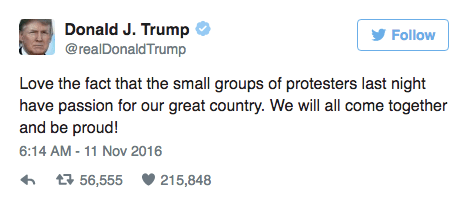
Add to this the fact that he has already backed off on promises to repeal Obamacare, one of the biggest pieces of legislation out of the last eight years that he has campaigned vociferously against for the entire election cycle, any my trust in his seriousness about enacting his plans is reduced even further. So perhaps I am being naive, but I really can’t spend too much time – yet – worrying about what he is actually going to do as president, in terms of policy. I will worry about it more once the rest of his team is in place and we have some actual indications of movement in the interplay between the branches of government.
And to be clear: if things start happening and it looks like he will make progress in achieving any of his major policy aims from the campaign, then I will enter full-on terror. I will denounce every such move in every way I know how, both with this blog with other actions (discussed below).
But in the meantime, as far as policy is concerned, what we are really left with is a state of total uncertainty. And that, in itself, is very scary. I don’t think we have ever elected a president before with so little idea of what he actually wants to do. Nowhere does this scare me more than in international affairs, in part because my understanding of foreign policy is much weaker than my understanding of domestic policy. I have always placed a lot of faith in the belief that our system, while obviously extremely flawed, would at least produce presidents who will be carefully guided by the best advice available and exercise extreme caution when it comes to negotiating delicate and potentially explosive relations with the other countries in the world. I do not feel that faith with Donald Trump, because everything we know about his temperament suggests he might do the opposite. But again, I just do not know. I cannot predict how he will behave. And not knowing, when the stakes are this high, is terrifying.
2. The Fear of Symbolism
And now let me get this out of the way. Donald Trump, while campaigning for president and in all the years leading up to it, has said a lot of really terrible things – and here I am not talking about policy, but about people. His statements have been racist, misogynistic, homophobic, xenophobic, disrespectful of people with disabilities, and generally lacking in concern or understanding for anyone who is not himself.
And it is fair to say that some of his supporters are dedicated to him for exactly those reasons. The Ku Klux Klan held a victory rally in honor of his election, for Christ’s sake. The National Organization for Marriage (which I falsely assumed had disintegrated since the Supreme Court ruling last year) is back and fired up about the prospect of reversing same-sex marriage. Ann Coulter, self-hating misogyny embodied, is already talking about how the protests against his election wouldn’t be happening if it weren’t for “fat girls.”
However, I do not believe that all of his supporters are all (or even any) of those things. My knee-jerk temptation, I will admit, was to lash out and label them all as such. In the initial depths of my despair – feeling so shocked and betrayed by this outcome I never saw coming – I was ready to latch onto any explanation I could. But after a bit more reflection, I realized that this was an extremely unfair generalization.
As I have come to understand and learn more about in the days since the election, a lot of people were voting for very different reasons, mostly tied to long-term economic shifts in the age of globalization. Trump’s election was unexpectedly secured in the rust belt – states that are facing a very different and very challenging economic reality, compared to just a few decades ago. The difficulty is that these arguments easily get very wrapped up in and muddled with arguments that do have racist, xenophobic, and sexist components. It is really hard to separate these things, and to know the extent to which the morally repugnant elements do or do not drive more benign and valid economic frustrations. But I am, in the spirit of magnanimity embodied by Hillary Clinton’s gracious-to-the-point-of-insanity concession speech, willing to (try to) assume the best, and understand these valid frustrations as much as I can, in the years to come.
However, this does not mean that I am not extremely bothered by the outcome of this election and extremely worried about what it means for racism, sexism, homophobia, xenophobia, and disrespect for the disabled in our country. We had a presidential candidate who openly embraced such themes in his campaign, to an extent we have not seen for decades. And then we elected him anyway.
Nate Black, someone who I do not know, but whose Facebook status ended up passing through my newsfeed, summarizes the issue more concisely than I ever could:
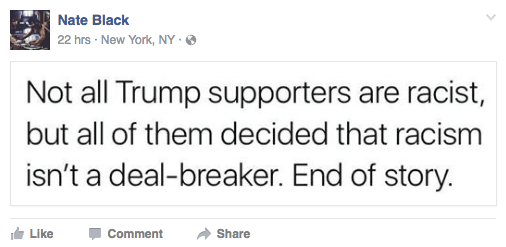
This is exactly what I found most difficult to grasp on Tuesday night, as the results rolled in and it became increasingly evident that Donald Trump not only could, but would, be elected. The American people are not a different people than we were a week ago. I do not believe that electing Trump has turned anyone into a racist, sexist, or any of the other categories discussed above. But the tolerance for people who do and say disturbing things, along these dimensions, is so much higher than I realized. And that means that the progress that we have made in recent years and decades, on social inclusivity and the protection of the rights of all Americans, is in a much more precarious place than I believed it to be.
What I fear most is that the people out there who hold these views and have no problem with the suppression and abuse of minority populations will be emboldened by the outcome of this election. Certainly that is a most pressing concern for avowedly disgusting groups, such as the KKK, who never let the movement toward equality and the normalization of respect stop them anyway. We have already seen more than a flurry of hate crimes, toward various minority groups, directly tied to the election. I think, or at least hope, that it is still too early to say whether this will become a sustained trend. But you can bet your ass that I will be watching, and doing everything in my power to combat such a trend, should it materialize (and even it it doesn’t – any hate crimes are too many hate crimes).
But I am also extremely concerned that it will happen at a lower, but much more widespread level. I am thinking of people like my brother, and other Trump supporters that I am related to. My brother is not, at his core, a bad person by any means. He is a privileged person (as am I), which is largely outside of our control. The problem is that he does not – and does not want to – recognize that privilege. He has no personal problems with the black, Hispanic, or other racial minority people that he knows and works with, and he would never wish them ill will. He loves and respects his wife to an astonishing degree (who, incidentally, makes more money than him).
But that doesn’t stop him from making inappropriate and sweeping generalizations and assumptions about all those from disadvantaged groups that he doesn‘t know. He once said to me, early in this past election cycle, “Well, we’ll probably have to elect Hillary to get the first woman president out of the way. Just like we had to elect Obama to get the first black president out of the way. Then we can just go back to electing whoever is best for the job.” And that sums up the entire problem. To him, electing the person who is best for the job obviously means “going back” – back to when we only ever elected white, male presidents. Because he is a white male, and because being a white male is just about the best thing you could be in this country, for one’s economic prospects, he assumes that is just how it should be.
He is the kind of person that, in response to police brutality and racially charged shootings, will immediately and unabashedly side with the police, instead of the black population protesting this behavior. And don’t get me wrong – I am not anti-police. But the one thing – more than any other – that impressed and moved me at the Democratic National Convention this summer was the defined realization that this is not an either/or issue. We can support the police force, as a whole, and support the Black Lives Matter movement that has risen up in response to specific incidences of police misconduct. Both sides have valid and legitimate concerns. Totally rejecting one side or the other is going to do nothing to improve the situation, but it can certainly exacerbate it dangerously, as it has.
I have tried, time and time again, to educate my brother about the concept of privilege. I have tried to remind him that we have parents who each only went to two years of college, themselves, but insisted that all of their children would graduate with a college degree. And not only did they demand it, they did whatever they needed to do in order to pay for it and make it happen. Because of where my parents started (which was pretty privileged for themselves, at the time), going to college was not optional in our house. I tried to contrast that with the with fact that for many people, and especially for minority people, it’s not that college isn’t optional, it’s that it isn’t an option. I have never succeeded with him, and I probably never will.
This is the kind of low-level racism (and sexism, and xenophobia, and homophobia, etc.) that is far more prevalent in the country and that I am, if not more worried about than the explicit variety, at least equally worried about. We had been making progress at normalizing the concept that these ideas, even if you still hold them, are not acceptable to discuss in public, or in general. And even though that is not a perfect fix, it means that future generations grow up in a less majority-oriented society, and that these problems will continue to diminish. The symbolism of Trump’s election is that all of this has halted, if not been dragged backward. It’s suddenly a lot more okay to say racist and sexist things in Trump’s America than it was in Obama’s America, because the president has said them himself (and, I would add, never apologized for them in any real way).
This, regardless of what Trump actually does (or what Trump actually believes) is the most real fear that I am grappling with, at the moment. Clearly, there are a lot of people out there for whom social justice is not a primary concern. If they are emboldened to pursue their own pursuits above all else, above any conception of what is or is not societally appropriate, I fear a grand regression toward a previous (and much worse) time in our social history.
Action
Alright, that is probably enough, for now, about why I am so concerned and so motivated to do something in the aftermath of this election. I probably didn’t need to explain any of that to the people reading this, because you probably feel the same way (or similarly, or worse).
So instead, let me conclude by summarizing what I plan to actually do about it (beyond expressing my thoughts, feelings, and progress through this blog). More than anything, this election and this unsatisfactory result has made me realize that voting is not enough. If I really want to be a positive force for change in our democracy, then I need to act. And I need to act daily, intensely, and purposefully, in order to achieve it. Perhaps the form of that action will continue to evolve into new and different roles, as time goes on – which I will use this blog to track – but here are the two main components of my plan, as I envision them now.
Part One
Donate, on a monthly basis, to key organizations that support causes and populations that I am very worried will be neglected and negatively targeted over the next four years. My current list includes:
- American Civil Liberties Union
- Planned Parenthood
- Human Rights Council
- The Nature Conservancy
- Southern Poverty Law Center
I welcome and encourage any other suggestions for other worthy and needy organizations, dedicated to doing good work for causes and people that require it. I believed I was electing a president that would make it a priority to improve upon all of these different areas. Instead, we have elected a president whose previous statements suggest that he may well like to work against most of them, and has started appointing people to key roles who give me little hope to doubt myself.
As such, it is up to me, and to us, to make the necessary efforts to help support them. I hope and believe that in our future elections we will be able to elect a government that will do this from the public sector. In the meantime (and even when our government is again sympathetic; in my Obama era bubble, I fully admit that I have neglected the importance of supporting private contributions to our societal ills) it is one of the best solutions I can come up with to make up the difference.
Part Two
As someone coming off several years of graduate school, living on a meager graduate student stipend during that time, my ability to financially contribute to the causes I care about is limited. But I am somewhat more able and more flexible in my ability to contribute my time and my work. I want to start doing that – and I truly lament that I have not done so before. It has been harder to identify specific organizations and causes, in my area, for which I can volunteer and which get to the root problems with which I am most concerned. But I am determined to find a good match.
On thing I would like to do, in particular, is to spend my time doing whatever I can to advance the cause of voting rights, the systematic suppression of which I believe significantly shapes the outcome of our elections. Even if it did not necessarily change the outcome of the presidential election this year (which some are claiming it has, but I am less certain), it has a very real impact on elections at lower levels throughout the country, and it has for a very long time. And even if it never shaped the outcome of a single election, it is a morally repugnant practice at total odds with the spirit of our democracy, and I want to fight against it in any capacity that I can.
Additionally, I pledge to dedicate my actual time and energy to the campaigns of candidates I care about, and that I feel will make the world a better place. In this election, Hillary’s forecasted success made it so easy to donate a few dollars, know that I was going to vote, and stop thinking about it. And in the midst of the many responsibilities of my professional life, it was easy to justify letting my commitment end there. But I was wrong, and I am ashamed. Despite everything I had going on, I also still spent a lot of hours watching TV or engaging in countless other pointless activities, when instead I could have been working toward ensuring the best outcome for our country’s future. Maybe it wouldn’t have changed the outcome, but at least I would feel so much less guilt if I had spent my free time contributing to this election, instead of being a (passionate) bystander. I will not make that mistake again. Democracy thrives when people are motivated to participate, and it thrives most of all when they are motivated participate beyond voting and to actually contribute their time and talents to the effort. I plan to do that, and hopefully continue to do it for the rest of my life. I am immensely sorry that this realization has come to late to change the outcome of 2016 election, but I’ll be damned if I ever fail to do anything in my power not to change the outcome of every election to come.
In Conclusion
With that, I will conclude this post. I intend this blog to serve multiple purposes over the months and years to come. For example:
- Further reflections and lessons on why this has happened and what we (as progressives, or as other concerned Americans from different ideological bents) can do to prevent it from happening again.
- Careful tracking of policy developments and alerts to problematic actions taken by the new administration, Congress, and the soon-to-be-altered Supreme Court.
- Updates on my personal progress, as I take on a newly heightened level of engagement in our democracy and our society.
- And maybe, every once in a while, something totally unrelated and fun.
This is my own journey, and I only intend it as such. But if it happens to be a journey on which you find yourself as well, and which you care to join and follow along, I welcome you with open arms. We are in for a few years that are cautiously fascinating, at best, and horrifying, at worst. I would never lament having more people along for the ride.
And now, here’s a picture of a couple puppies that should be too cute to legally exist:
 Doctor Dvorak's Delirium